Saturday, April 30, 2016

THE FOOL - DREAMS AND NIGHTMARES


TAROT AND THE FOOL

The cards called the TAROT have no known origin. Yet, it is a very powerful mystical tool. From its earliest creation (some say Egypt) the TAROT was infused with highly psychic images meant to provoke particular energies manifesting themselves as thoughts and feelings. Just like a dream image, the Tarot images include universal symbols also called Archetypes.

This article is not meant to reflect on the TAROT and its meaning but begin a thinking process about how images are reflected in our dreams. So we begin to reflect on the FOOL or Madman. It is the only card out of the 22 major arcana that has no number – only 0. The FOOL cannot be pinned down to any interpretations and is an open symbol. It may represent and unlimited energy, total freedom, holy madness, chaos and also the primary creative and destructive energy.

The FOOL walks on an unknown path. We may say his journey is about all paths. He is the eternal traveller that just roams the world without a specific goal. Or perhaps he is a pilgrim walking towards an unspecified sacred place. Or, again, he is a madman that is walking toward his own destruction.

However, he is also a symbol representing a young dreamer. Someone that is free like a bird. Nothing is blocking him - he simply follows the cosmic life energy. The FOOL is also a musician represented by the bells attached to his dress. As we look at the figure, we may also notice the three elements of creation (manifestation): Creation, Conservation and Destruction. His path includes danger and he may step out into an abyss, but his dog (animal nature) is gently warning him to be aware. The dog is contacting his master’s back, a place indicating the base chakra (muldahara) that connects with the earth.

Here we may stop and reflect about our dreams and dream symbols. Dreams connect us with that free floating energy that we perceive in the FOOL. As we meditate on our dream symbols, we become interested in the minute details of the dream symbols: what are they saying to us? So, like in dream work, let us take a moment to ask the FOOL to speak:

“Do you know that in every moment you may change your perception of reality?”

“Expand your field, do not rest and keep on traveling”

“Leave all beliefs that you have regarding others being better than you, stronger than you”

“It is not your purpose to lose consciousness, abandon freedom or give up”

“Let your inner madness guide you.”

“The spirit (intuition) that you have is your best teacher/guide.”

“Until now you have lived in the rational realm, not paying attention to other life energies. Become aware of the great ocean of unconsciousness”.

“Live fully and totally in body, mind and spirit”.

The Tarot is not only a divinatory tool but it also gives us guidelines to understand our own dreams. It gives us a clear view of both sides of human fate: the wonderful and the nightmarish.

Dreaming our reality

Some researchers of dreams have found that our minds naturally create stories around the facts of our lives and those personal stories strongly influence how we perceive ourselves as well as how we behave in real time. When recurrent themes are being felt as triumphs over adversities and how our troubles are resolved, we feel good and have a lot of courage. However, with stories that focus on the dark and negative results that destroyed our happiness, we are likely to experience fears, apathy and depression.

In addition to our personal dreams we share a collective dream based on social, spiritual and cultural scripts. We learned about ideas as to how we should live our lives and measure our worth and happiness. All collective nightmares created by others (wars, terror and evil) have a strong input into our own perception of reality.

This perception of nightmares is based on focusing on problems in all the digital media available today. All or most of our energy is spent on reading about, thinking about and noting world problems. What we need is to focus on and re-imagine a world that has harmony and wellbeing.  Have a vision beyond the collective nightmares (reflected in bad news) – we can actually dream this vision into being!

When we operate from a higher level of consciousness, we stop perceiving ‘problems’ and start perceiving ‘situations’ and opportunities that are neither good nor bad. They are simply here and now giving us a point of view from a creative awareness and then we begin to note opportunities in every dark space.

When we become paralysed in a nightmare, we lose any notion about how we can enjoy a sense of purpose and be free, like the FOOL in the Tarot card.


         Different representations of the Fool


The next post will give you a full understanding of dreams and nightmares from a gestalt perspective. 


DREAMS AND NIGHTMARES - A GESTALT HYPOTHESIS

This article is based on the writings of my good friend Martha Preciado, now deceased, who was the director of the Gestalt Institute of Guadalajara, Mexico. I was visiting Mexico in the 1990's and did some training in that Institute. Martha was a great leader and therapist and inspired many students, now graduates, to carry on the excellent gestalt tradition. I have the honour of translating her paper from Spanish and invite the reader to reflect on her ideas and give me feedback later.

 
DREAMS AS NIGHTMARES – A GESTALT HYPOTHESIS
            By
 
Martha L. Preciado – Translated from Spanish by Yaro Starak
 

Introduction

 
Working with dreams as a gestalt therapist gives me great personal insight as a human being and it also enables me to be in touch with my own magical/symbolic part.
It is also a wonderful opportunity to enable people to become more whole and more in touch with their existential self. When this happens, the person discovers more energy for living a fuller life, takes more risks or challenges in their daily life and for many it fulfils an inner purpose or destiny that life presents them.
As a gestalt therapist, I have often reflected deeply on the issues that our dreams place before us. Of particular interest to me are the dreams commonly called “nightmares” In my own experience and in the experience of many other psychotherapists the following are the basic questions that arise when we work with nightmares:
 
  • What do nightmares offer us?
  • What special messages does the nightmare send us?
  • Can we learn and develop further by working with our nightmares?
 
When I work with clients that present their dreams as nightmares, I find that they have a strong urgency to do something about their dream. They either want to get rid of these nightmares quickly or want to find out why they are coming to bother and frighten them.
Gestalt therapists often work with recurrent dreams and nightmares. The fundamental grounding literature about nightmares points out to the notion that nightmares consistently produce strong feelings of anxiety, fear and horror. They are experiences that often are related as some sort of horror movies.
However, such simplistic answers are not enough and as a result I began to focus my observations carefully on my clients’ nightmares in my own practice. My observations led me to the following hypothesis that will be elaborated in this article. First, let us review the question more specifically: “what are nightmares”?
 
What Are Nightmares?
Nightmares have at least two specific and distinguishing features:
 
(a)    They are charged with a high level of anxiety. This anxiety is experienced for some time, even after the nightmare is interrupted and the person is fully awake and
(b)   Nightmares bring about strong, frightening images but often, when a person awakens, he or she will not have any sense of fear or anxiety about them.
 
For example, a client reported a dream/nightmare and stated that she dreamt of a cup with red liquid and she was sure that this cup was full of human blood. After this nightmare the client had a major anxiety attack and was afraid to go to sleep.
Another client of mine presented the following image: She dreamt of a deformed, mutilated female body without legs or arms and was covered with wounds smelling quite putrid. However this client had no particular feelings about this dream when she spoke about it.
Although in the first case the dreamer had a strong reaction to her image, and while in the second case there was no affect present, both dream experiences can be classified as nightmares. In many cases nightmares are experienced following a traumatic event. Such an event may be an upsetting horror film, experiencing a shock, being in or watching an accident or having an unusual amount of stress in life which precipitates fears and worries.
For example, one client reported that after her divorce she had the following nightmare: “ I am at a café, sitting and reading a book. Suddenly a man enters holding a big knife in his hand. He begins to kill every customer in the café and I feel that he is going to kill me any moment now. I feel totally frozen and unable to move because of this horrible fear I have. I wake up in a sweat.”
 
Some Theoretical Reflections about Nightmares
Gestalt therapy has developed a special method of working with dreams that has a specific therapeutic outcome. Dream work is a subtle way of entering into the “magic” world of the client’s inner self. However, the therapist enters this world carefully not interpreting the meaning. Also without leaving behind the process of healing by using the therapeutic method.
The basic philosophy of gestalt dream work is to re-integrate the disowned (split) parts of the inner self with the purpose of promoting a healing of the whole person. We call this process ‘the holographic principle.’ We follow the assertion that the dreamer creates all parts of the dream. No one else is creating the dream. A dream is totally and fully our own production, our own drama and our own direction.
If this assertion is true, then all that constitutes a dream is our own projection phenomenon. Fritz Perls was the first proponent of this assertion. He stated that our own disowned parts of the self are expressing themselves in the dream as if it were a play on stage. However this principle is not as simple as it appears to be. Since we may identify with each of the parts in the dream, we also develop an automatic resistance to these parts. We will invariably resist the images in the dream that are not too attractive, pleasant or acceptable to us. For example we may ask; who wants to identify with a dirty pig, a killer, an evil or a horrible monster?
In the case of nightmares, where images are extremely frightening and negative, we naturally tend to refuse to confront such parts, let alone identify with them.  We experience these horrific images as a direct threat to our personal integrity and our own idea of sanity.
The second theoretical reflection is about the gestalt notion of “unfinished business”. This means that something is in the foreground of our awareness and the rest is in the background and hidden from our awareness. When an experience in our life is not complete (finished) the figure/background process tends to become rigid and develops a protective ‘guardian’ that may appear as a ‘solution’ to what has been an unfinished situation.
For example, if I am a child, and I am lacking the maturity and perspective in solving life’s problems, I am not able to handle the attacks upon me by my alcoholic or abusive father or other such difficult and painful situations. As a result of this trauma, I develop a protective pattern of splitting away from my body whereby I will not feel any pain when I get maltreated.
As I grow up this protective pattern is repeated again and again when I encounter what I perceive as abusive situations with others. In spite of the fact that many of these situations I can handle perfectly well as an adult, my early familiar pattern gives me immediate although temporary relief. In time this pattern may develop into what we call “a frozen gestalt” and become a compulsion, a neurotic habit, an addiction or become entrenched in body symptoms. In other words, I develop an avoidance pattern called retroflection.
Retroflection is an internal body symptom that emerges when we do to ourselves what we want to do to others. (I want to fight back and hit my father and instead I fight with myself).
In nightmares we often experience both phenomena at the same time – retroflection and projection. For example, I am dreaming that I am being violently attacked, dismembered and feel like a victim but also in this dream I am the aggressor who attacks and inflicts the pain. Now, what follows is my hypothesis as a result of my practice in working with nightmares.
 
Hypothesis
A scenario: There were times in my life that I experienced a traumatic or difficult situations in which I had a wish/desire/urge to retaliate or release my natural aggressive impulses. However my impulses were stopped by stronger or more powerful opponents. As a form of defence, I retroflected (turned against myself) my aggressive impulses and developed symptoms that enabled me to deal internally with the unfinished situations that required finishing outside myself. This repressed/aggressive energy I turned against myself and as a result I developed pseudo-solutions to my issues like self-hate, low self-esteem, self-mutilation, addictions and so on.
And so, while sleeping I begin to dream of being aggressive and project my aggressive impulses onto images that become so strong that they bounce back at me as nightmares. Thus the process of retroflection and projection goes in both directions – into/against me and out of myself and against others while I am asleep.
 
Working with Nightmares in Gestalt Therapy
Working with nightmares using the gestalt approach we often experience new resolutions to the problems presented by the dreams. Here is a brief description of the steps we undertake in such work:
  • A person narrates the nightmare in the present tense (here & now).
  • The therapist encourages the client to select an image that may be at this moment most significant, strongest or in the person’s foreground.
  • The client is encouraged to become more aware of the specific details of this image.
  • Invariably the aggressive (energetic) impulses will emerge and are explored in the here and now situation.
  • The feeling of excitement/anxiety may be amplified at this time in the context of the ‘safe emergency’ of this session.
  • The therapist enables the client to ‘stay in the present’ and encounter the dream image.
  • There may be an opportunity for a dialogue with this strong image, however, the mere facing the image may be enough.
  • The therapist pays particular attention to the emerging unfinished business in this encounter as it unfolds in the session.
  • There may be strong, aggressive language, powerful feelings, memories of earlier experiences, emotional release and so on manifesting itself as the blocked  energy is released behind the unfinished situation.
  • Next the therapist pays close attention to the retroflective patterns (e.g. Self-fulfilling prophecies) that may appear as a “frozen” figure, a sense of losing power or losing energy altogether. Here we may see the ‘impasse’ phenomenon.
  • The therapist does not attempt to change anything but simply supports this process as it is.(paradoxical theory of change).
  • When a strong figure emerges, from this impasse, the therapist encourages the client to re-identify with this figure.
  • In the supportive environment of the therapeutic session, the client is encouraged to identify with and take the position of the strong figure in the dream and make contact with it.
  • Having identified with this figure the client enters the dream once more and expresses him/herself fully as this dream figure, e.g. “I am the Devil!”  “I am the witch!” “I am the killer!” and so on.
  • The nightmare scenario is recreated again with the support of the therapist and work continues until the unfinished situation become complete and no longer threatens the client with nightmares.
As a working example, a client began to express images of a nightmare that appeared intransigent (uncompromising) and began to get stuck in a ‘frozen’ figure.  Suddenly a memory came up of a time when she was a teenager and in a relationship with an older man. She reported that he was often violent and abusive to her and this lasted several years. She felt powerless and stuck, unable to leave him. She also felt guilty and remorseful about the relationship.
In the nightmare she is watching a cement truck covering the streets not with cement but with a dead body that someone threw into the cement container of this truck. The truck was ‘cementing’ the streets with what she described as a “human mixture”.
The therapist recreated the dream asking her client to be the driver of that cement truck and put the man she felt abused by in her life in the container of this truck. While she identified with the truck driver she began to imagine that she is covering the streets with his material and his persona and began to shout: “yes, yes, it is him and he is in my truck” While she drove the truck in this recreated dream she began to say: “here I am cementing al my insecurities that are left from that time with him”, Now I am cementing all my fears of new relationships”……..and so on.
The therapist kept monitoring her feelings and supporting her strong ability to act both physically and emotionally in the new dream scenario.
After this enactment of the dream, the client stated that she felt rather strong, satisfied and happy about the way her life went on. She became more integrated in her relationship with others by not feeling so powerless in the presence of men. When asked what the nightmare’s existential message was for her she replied: “the dream said to me that it is time that you take charge of your life, you are strong and capable now and you can heal yourself!”
 
Conclusion 
Gestalt work with nightmares is mainly intra-personal; it enables a client to combine the left brain activity of the narrative and the right brain activity of the created images. In this way the person can develop new tools for living a full life.
By integrating our interior life we will be able to integrate fully our interpersonal world and increase our capacity to grow and relate with others more fully and in a new way.
In gestalt work with nightmares the outcome is often positive, the nightmares disappear and life becomes a joy to live.
In the meantime, the therapist must be in close contract with the client for some time to ensure that the inner process is no longer psychologically disturbing and that the client has fully finished what the inner world of dreams is presenting to him or her.
I trust that this short article and my hypothesis within, may be of some help to therapists that attempt to enter the world of the nightmare and shed some light on some of the least known, murky and shadowy aspects of psychotherapy.
 
References:
Ferud, Sigmund; 1948. “Introduction to Psychanalysis” part 3 in the “Dreams” section.
Perls, Fritz; 1974. “Dreams and Existence” Editorial 4. Vientos, Santiago de Chile Publisher.
 Downing, Jack & Marmorstein, Robert;  1973, “Dreams & Nightmares” Harper and Row publishers.


Fritz Perls by Otto Dix, artist.


Sunday, March 20, 2016

REFLECTIONS ON GESTALT AND CONTEMPORARY THERAPIES


REFLECTIONS ON THE CONTEMPORARY THERAPIES


After some 35 years of teaching and the University of Queensland and training gestalt therapists all over the world, I am now reflecting on this so called “talking cures’ or as the contemporary writers call it “relational therapies”. 

Millions of people seek some sort of psychological help assuming (believing) that a professional will be able to sort out their complex life problems and/or at least help with their relationships.  However, the first question is how to select from a huge list of available therapeutical modalities that seem to mainly be interested in making money because there is no clear evidence that the “talking therapy” actually helps but there is some evidence that it can hinder solutions or create more problems to the many individuals, families and eventually to whole societies.

Take a brief look at history of humanity. Here we discover that prior to the emergence of therapies, spouses, parents, lovers, children, and all sorts of close friends and colleagues – that were not therapists – were considered the most important people in our lives and the most available to help. Now the many psychotherapies place the professional helper in the middle of the ‘lay folk’ and make the ‘expert’ the most important problem solver. Many who practice as a way of earning a living, deliberately promote themselves as the true expert in human relations and thus degrade what for centuries was a wealth of wisdom regarding human growth and development: the tribe, the family, the group and society.

Research reports about questionable results in therapy are usually criticised or simply ignored. As far back as 1952, H.J. Eysenck, a British psychologist, begun the practice of scientifically examining the effectiveness of psychotherapy with the ‘common neurotic person’, he compared the recovery rates of persons not treated with those treated with psychotherapy. He concluded that psychotherapy was ineffective promoting recovery from a neurotic disorder.

We know very well that there are a large amount of methods and techniques of psychotherapy and each claim specific results. Like psychoanalysis that helps to understand the nature of inner problems to Humanistic therapies that share and reflect on the clients’ feelings and emotions. CBT or behavioural techniques that instruct the client to stop negative patters of thinking and so on and on.

Nevertheless, in the many years of research, all the evidence points to only one factor that enables growth and helps with problems is: RELATIONSHIP. The client-therapist quality of relationship they experience in any sort of therapy. We may claim that our specific techniques or methods are effective in comparison to others, we cannot deny that the relationship between the client and therapist is key to developing a positive or negative outcome of therapy.

It is obvious, then, that any orientation that we may have chosen to be trained as a psychotherapist, the major skill is to learn how to develop a positive, conscious and ongoing relationship with the client in order to achieve measurable positive outcomes in therapy.


GESTALT AND THE CREATIVE PROCESS

In Perl's (1977) formulation of the goal of treatment, self-expression and awareness on the nonverbal level also play an important role:

The treatment is finished when the patient has achieved the basic requirements: change in outlook, a technique of adequate self- expression and assimilation, and the ability to extend awareness to the nonverbal level. He has then reached that state of integration which facilitates his own development, and he can now be safely left to himself to continue life as a healthy journey.

There are many new studies that carry the title of “Psychoneurology”, “Biopsychology”, “psychobiology” and so on. These studies use the new brain scanning technology to determine the therapeutic outcomes. At the 2014 GANZ (Gestalt Australia & New Zealand) conference in Brisbane a key note speaker was a brain researcher from the University of Queensland. He specifically outlined the positive therapeutic outcomes working with Gestalt Therapy. I felt overjoyed about this evidence because it finally acknowledged the many years of experience of working as a Gestalt therapist and trainer that this particular therapy does train practitioners to make clear and positive contact (relationship) with clients and groups. Gestalt also includes in its training a large input in creative experiential and experimental techniques.

The quote by James Dewar “minds are like parachutes, they only function when they are open” is a wise one. He suggests that books, theories and intellectual jargon only aims to keep the mind closed to experience. It is clear that all therapeutic orientations that span over 100 years now, are required to enable the client to “talk about” issues or problems and that is supposed to relieve them form psychological stress.

Only Dr. Fritz Perls and his wife Laura pioneered the notion of an authentic encounter with the client. They used many expressive therapies (including body work) that generated feelings of anger, sadness, disgust, joy, sexuality, etc. He often spoke to clients to “stop mind fucking” and experience the NOW! Perls worked in a small group format where he encouraged members to express , explore and share openly their inner feelings instead of ‘talking about’ them.

Talking about does not help to solve many problems deeply ingrained in human beings. It actually helps to fill out the ‘therapy’ hour creating an illusion for the client and therapist that something very important is happening.

Gestalt Therapy has deleted that illusion from its methodology and instead promoted the sense of AWARENESS. Awareness is a process that happens only in the here and now (present) and has the potential to shift the client’s life-space by enabling the understanding of deep relationship with the whole spectrum of personal, transpersonal, existential human growth.

One of the mayor developments in the Gestalt therapy field is the awareness of the creative process in healing Body, Mind and Spirit. Joseph Zinker pioneered this idea in his book: “Creative Process in Gestalt Therapy” (1978).
 
 
 Joseph Zinker

GESTALT AND JOSEPH ZINKER

 According to Zinker, Gestalt is a creative approach, which may include drawing, playing, dance and drama. The therapist will be willing to engage in a genuine relationship with the client, within appropriate therapeutic boundaries. Exploration of this therapeutic relationship will form an important part of the therapy. The therapist may set up an experiment to aid the client in more fully experiencing and expressing a current sensation or work with art tools like drawing, painting, mask making, sculpture, theatre, dance, collage etc.

Gestalt therapists believe that unfinished business underlies much human distress and will support clients in reaching resolution in those areas of their lives where they feel incomplete. This may involve the safe expression of pain, anger, sorrow, fear and joy. Often, relief follows the release of emotions which have been held back, especially if they have been held over a long period of time, perhaps because such expression would have been unsafe. Art tools enable the clients to put outside themselves what is inside and then can work on the figure presented in their art work.

Gestalt therapists further believe that all of us contain aspects which are loving, cruel, hostile, joyful, adventurous, timorous and so on. Integration occurs when we own and accept all that we are, rather than pretending to ourselves and others that we are always kind, or brave or hard-working or whatever. Thus the therapist will also support clients in discovering, exploring and reclaiming parts of themselves which they have disowned. Drama using puppets and sand tray are some of the most powerful methods to help the integration of dis-owned parts.

 Photo: Y. Sarak copyright
 
 
 [2]A BRIEF HISTORY OF ART THERAPY

Although art therapy is a relatively young therapeutic discipline, its roots lie in the use of the arts in the 'moral treatment' of psychiatric patients in the late 18th century, this moral treatment, Susan Hogan argues, “arose out of utilitarian philosophy and also from a non-conformist religious tradition”, and in a re-evaluation of the art of non-western art and of the art of untrained artists.

Art therapy as a profession began in the mid-20th century, arising independently in English-speaking and European countries. The early art therapists who published accounts of their work acknowledged the influence of aesthetics, psychiatry, psychoanalysis, rehabilitation, early childhood education, and art education, to varying degrees, on their practices.

The British artist Adrian Hill coined the term art therapy in 1942. Hill, recovering from tuberculosis in a sanatorium, discovered the therapeutic benefits of drawing and painting while convalescing. He wrote that the value of art therapy lay in "completely engrossing the mind (as well as the fingers) …releasing the creative energy of the frequently inhibited patient", which enabled the patient to "build up a strong defence against his misfortunes". He suggested artistic work to his fellow patients. That began his art therapy work, which was documented in 1945 in his book, Art Versus Illness.

The artist Edward Adamson, demobilised after WW2, joined Adrian Hill to extend Hill’s work to the British long stay mental hospitals. Other early proponents of art therapy in Britain include E. M. Lyddiatt, Michael Edwards, Diana Raphael-Halliday and Rita Simon. The British Association of Art Therapists was founded in 1964.

U.S. art therapy pioneers Margaret Naumburg and Edith Kramer began practicing at around the same time as Hill. Naumburg, an educator, asserted that "art therapy is psychoanalytically oriented" and that free art expression "becomes a form of symbolic speech which…leads to an increase in verbalization in the course of therapy. Edith Kramer, an artist, pointed out the importance of the creative process, psychological defences, and artistic quality, writing that "sublimation is attained when forms are created that successfully contain…anger, anxiety, or pain.” Other early proponents of art therapy in the United States include Elinor Ulman, Robert "Bob" Ault, and Judith Rubin. The American Art Therapy Association was founded in 1969.

National professional associations of art therapy exist in many countries, including Brazil, Canada, Australia, Finland, Israel, Japan, the Netherlands, Romania, South Korea, and Sweden. International networking contributes to the establishment of standards for education and practice. Diverse perspectives exist on history of art therapy, which complement those that focus on the institutionalization of art therapy as a profession in Britain, the United States and Australia.

The purpose of art therapy is essentially one of healing. Art therapy can be successfully applied to clients with physical, mental or emotional problems, diseases and disorders. Any type of visual art and art medium can be employed within the therapeutic process, including painting, drawing, sculpting, photography, and digital art. Art therapy stands in contrast with other kinds of creative or expressive arts therapies that use dance, music or drama. One of the major differences between art therapy and other forms of communication is that most other forms of communication elicit the use of words or language as a means of communication. Studies have demonstrated the efficacy of art therapy, as applied to clients with memory loss due to Alzheimer’s and other diseases; stroke residuals; cognitive functioning; traumatic brain injury; post-traumatic stress disorder (PTSD); depression; dealing with chronic illness; and aging. However, the potential healing power of art therapy has not been thoroughly studied in certain patients, such as trauma victims with disorders such as PTSD. Art therapists report remarkable results from work with combat veterans, traumatized victims, sexual abuse survivors and survivors of natural disasters. Published case stories and research projects also support the efficiency of the approach. As art therapy grows in popularity and gains recognition, the purpose will become more clear and branch out to different patients. The purpose of art therapy is to provide a new healing opportunity to those who will benefit most from alternative therapy methods. In conclusion, art therapy is one of multiple methods to create peace and healing. Gestalt Art therapy has only recently developed and is growing.

PS: Watch this very informative talk by philosopher Alain de Botton: “Art as Therapy”


GESTALT ART THERAPY CENTRE

The Centre begun in 2008 when Yaro Starak and Gemma Garcia arrived from Spain. Both completed their training in Gestalt Therapy and Gemma received a diploma in Visual arts in Brisbane. Combining art therapy and gestalt was a project that opened opportunities for anyone who is interested in learning how to apply art tools in working as a gestalt therapist and also for those who were not trained in gestalt, to learn to become more proficient in their work. The fusion of both methods created the first Centre of Gestalt art therapy in Australia. The reader is invited to click on the links below and discover the story with all the details.


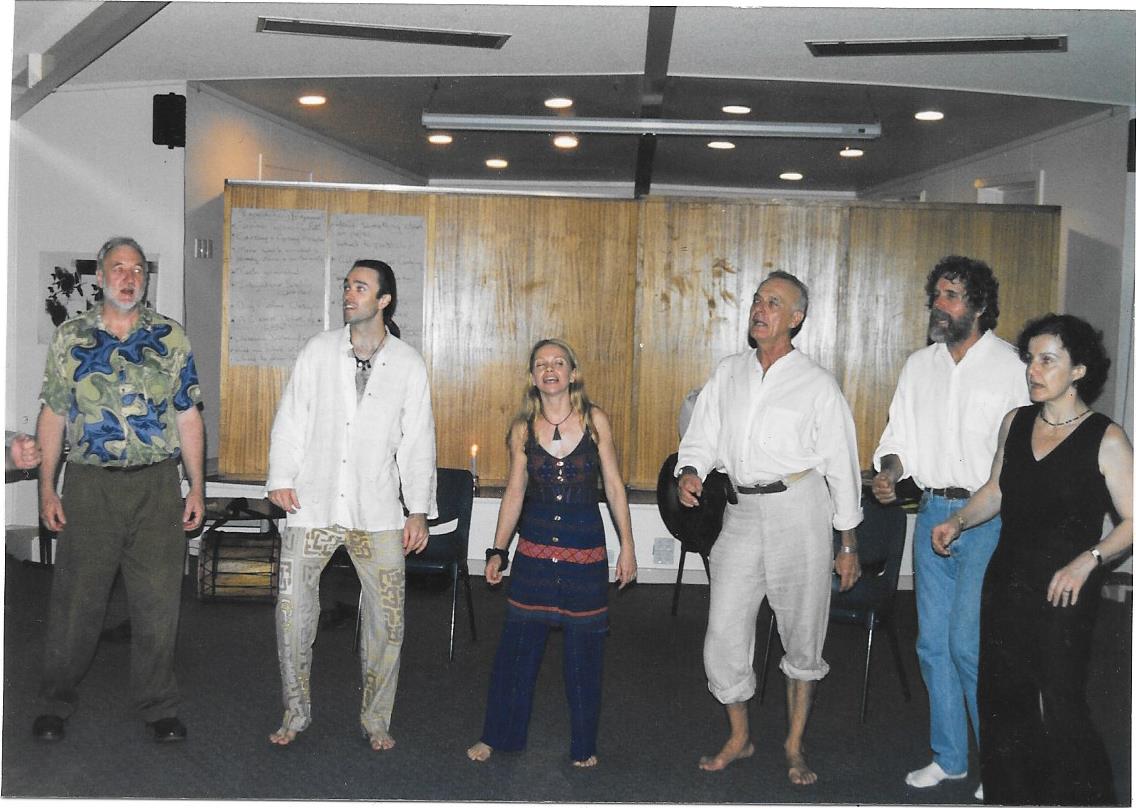
GUESS WHO ARE THEY? WHERE and  WHEN? (hint: GANZ)


Friday, January 15, 2016


REFLECTIONS YARO - JANUARY & FEBRUARY – 2016.


I want to begin this new “reflections” paper with a poem I wrote at the time my teacher, Jorge Rosner died in Toronto, Canada.
SEVENTY-TWO AND BLIND
I am seventy-two and blind.
I know where I am, dear wife.
Where are you?
I know where I am, my dear daughters.
Where are you?
I know where I am, my dear friends.
Where are you?
I am seventy-two and blind.
I smell the fragrance of the flowers.
I know where I am.
Where are you?
I am seventy-two and blind.
I imagine the majesty of the trees.
I know where I am.
Where are you?
I am seventy-two and blind.
I can taste a good book.
I know where I am.
Where are you?
I can hear the children laughter.
I know where I am.
Where are you?
I am seventy-two and blind.
I experience the fullness of existence.
I know where I am…
Do you?
Jorge died on May 14th 1994. This is a time, now, to celebrate the man who knew Fritz Perls and then developed the Toronto Gestalt Institute in Canada and was its director until the end of his life.
One interesting way to make Jorge ‘alive’ again is to offer to readers an interview he made in 1980’s
The interview is about Jorge and how he met Fritz, the major founder of Gestalt Therapy.* Dr. Charles Brodeur is the interviewer:
CHARLES: When did you first meet Fritz Perls?
JORGE: I met Fritz in 1966. I wanted to speak with him, but he obviously didn’t speak to strangers, so I made no attempt. We just passed each other. That was in California, at Esalen. Then my friends and I invited Fritz to give a seminar in Chicago. Fritz came to Chicago and we got together for the seminar. Mostly, I remember his fantastic timing, the sense he had of his audience.
When he finally started to work, he asked who wanted to work. Since I had never so-called “worked”, I didn’t know what the hell it was all about. It didn’t seem like a big deal, so I got up and worked.
CHARLES: Did that experience with Fritz hook you on Gestalt?
JORGE: No, I still wasn’t hooked after working. In fact, I didn’t know what I got out of it anyhow. It was a demonstration for the rest of the audience. Fritz asked me to attack him. I did the normal thing. I told him, “I don’t know you; how can I attack you or say something I don’t like about you?” He repeated the instruction. I told him that he was a chain-smoker, and I didn’t like that about him. That evening there was a party. Fritz was there, and I went up to him to apologize for saying what I had said. I didn’t even get the apology out when he said to me, very clipped and sharp, something like: “You said it. It’s your responsibility.” He then turned and walked away from me. My immediate reaction was to get angry at him, thinking him rude and crude.
Later that evening a light lit up somewhere in my head. Whether or not he had been considerate, I had agreed to do what he had asked. As far as I was concerned, he was right. Whatever I say, prodded or not, is in fact my responsibility. I was intrigued by the man, and at the same time had no desire to learn Gestalt Therapy. I was intrigued by his personality. I wanted to know more about Fritz, about the person, about what I called his neuroses and his strengths. That was the way I got hooked, by the personality of the man himself.
CHARLES: What further contact did you have with Fritz after that encounter with him in Chicago?
JORGE: I met him again in California, at Esalen. Our meetings went on like this for some time. Since we could be with him only a few times in California, my Chicago friends and I invited him a number of times to Chicago for weekend seminars. Until the time of his death, I met with Fritz on a fairly regular basis. I spent time with him privately as his chauffeur and companion when he was doing demonstration-lectures in Chicago.
In this way I was able to get to know and appreciate Fritz. The more I saw of him on a person basis, the more I was hooked. With Fritz, I experienced Gestalt as a way of life, and not simply as a specific modality of therapy.
CHARLES: Can you recall any other memorable impressions of Fritz aside from your first meeting with him?
JORGE: I spent some time with Fritz, either at luncheons or driving with him, sharing views of many people in the United States that we both knew. I enjoyed listening to Fritz with his one-line capsules of these people. They were like little cartoons for me. What really connected me to him as a teacher was his way of seeing. I enjoy seeing things pictorially. He could do that very, very well.
CHARLES: How did Fritz influence your work and your own personal life-style?
JORGE: I certainly increased my awareness from knowing Fritz, awareness of myself and others. I also increased my sense of responsibility. I now accept that any and every act or statement of mine is my responsibility. With this insight has come a tremendous difference in my sense of freedom. Looking back, I realize that what I gained most from Fritz is a deeper appreciation for what freedom means to me.
CHARLES: I experience you as a person with great respect for individual freedom, as well as a person with seemingly unlimited resourcefulness. How did you achieve this?
JORGE: By taking responsibility for my life. This is very clear to me. I am responsible for whatever I say, think or do. In this way I am free.
CHARLES: How do you see yourself doing things differently from Fritz?
JORGE: I wouldn’t say that Fritz was a scholar, although I know that he was well read. Also as a psychiatrist, he had a rich background in the field of psychotherapy. My training was my experience in surviving, taking responsibility for making my own way in the world, creating my own jobs for a living. What I bring to my work is a greater clarity about my responsibility and what responsibility means. I also bring into my work, which may or may not be called therapy, an understanding that life as we now live it is in our own hands, that each and every one of us can in fact be freer, fuller human beings.
CHARLES: How are you now experiencing that freeness and fullness in your own life?
JORGE: By making choices. Sometimes I do not immediately act on the choices that I make. If I have the little picture in my mind of what I want, I set my path, my work, my way of life in the direction what will get me where I want to go.
CHARLES: What are some changes or choices that you have made most recently?
JORGE: Most recently I have been living out a somewhat schizophrenic existence. I always have had a great need to be productive in this existence. At the same time I always have had a great need for privacy, to be alone, to be quiet, to have more time for what might be called an inner search for who I am. My present way of doing this is to live on my farm, where there is no talk of therapy or of administration or business. Then I spend some time as director of the Gestalt Institute. It’s not a matter of my simply changing locations geographically, or going into another setting of therapeutic work with different individuals and groups. What I am doing is much more difficult; I am jumping back and forth into two totally different life-styles.
Now I am experimenting with living out these two life-styles. I don’t know my next step yet. When I have a desire, a need to fulfil myself in another way, I will most probably go that way. Since Fritz, I see this process as uncovering more parts of myself, experiencing myself more and more as a fuller human being. Before Fritz, before Gestalt, I didn’t know how to do this.
CHARLES: How would you sum up your impressions and experience with Fritz?
JORGE: Not many human beings, in my experience, have the courage that Fritz had to live out the very depths of their neuroses, their hell, in order to live honestly. We may call them neuroses, or whatever. Fritz was the only person I have ever known who was ready to live his life as honestly as I experienced him to be living. Of course, in that honesty were many strange parts to the man. As far as I could see, however, he was honest to himself. For me, in his own way, Fritz had integrity . . . and kindness. I know many who hated his guts and might have called him cruel. What I saw was a profound sense of caring, both in his work and in what he was doing with his existence. If someone wanted to work with him, Fritz would give that person encouragement and support. This is what I remember about Fritz - his integrity, his strength.
*Charles Claude Brodeur, PhD is an Associate Professor of Psychology, Faculty of Education, University of Toronto, Canada
 

   Working with the 'Hot Seat" in Brisbane, Australia.
Having looked at Jorge Rosner from the perspective of his learning from Fritz, I want to continue to write about MY encounter with Jorge and how he ‘hooked’ me to study Gestalt Therapy.
I first met Jorge in 1971 as my trainer and teacher in Toronto, Canada. I was one of the selected 25 students to form the first Gestalt Institute of Toronto training group. He came to run our group the first night and I was petrified with fear of his huge presence. For the first year of my training, I was avoiding what he called “hot seat work”. I was ‘into’ observing the ‘work’ of others who would jump at the opportunity to be working with Jorge. He came from Chicago every weekend  to lead the workshops while Dr.Harvey Freedman would do the training in the evenings every week. We also had trainers from USA such as Stella Resnick, Tom Munsen, Laura Perls, Isadore  From and others.
Jorge worked with Fritz Perls from the time he met him at a workshop in Chicago. Dr. Frederick (Fritz) Perls, originally a Freudian analyst, was influenced by the principles of Gestalt psychology and existential philosophy, and by the many new approaches developing in the late 1960’s. Fritz  Perls impressed his students and the world with therapy training that was unique, dynamic and on the leading edge. He incorporated contact with the therapist into the client’s work and was well known for his “hot seat” method in group therapy at Esalen, California.
 Jorge Rosner came to work in Toronto with Dr. Harvey Freedman. Dr. Freedman studied with Fritz until September 1969, at that time Dr. Perls, then living at Lake Cowichan, British Columbia, Canada, appointed Dr. Freedman as Clinical Director of his Gestalt Institute in Canada on Vancouver Island – a position he planned to take up the following year. When Fritz died in Chicago in March of 1970, Dr. Freedman and his family cancelled their plans to move to Vancouver Island. Instead, in September 1970, with the help of Dr. Harold Silver and Dr. Peter Brawley, he founded the Gestalt Institute of Toronto and established an official space at the Faculty of Medicine at the University of Toronto.
In 1971, during a trip to Mexico for a conference, Dr. Freedman met Jorge Rosner, who had trained at the Gestalt Institute of Chicago that enjoyed frequents visits by Fritz Perls. At that time Rosner was a contemporary and colleague of Virginia Satir, Alexander Lowen, and Alan Watts. Dr. Freedman invited Rosner to come to Toronto to give a demonstration workshop, which was very well received. Dr. Freedman then invited Rosner to join the Faculty of the new institute. The work they did drew large numbers of students to the program. Together with other Faculty members, like Yaro I. Starak, James Oldham and Tony Key, they developed an approach to training leaders and therapists, which continues as the basis of present day programming at the Institute. Dr. Freedman once described Jorge Rosner as one of the most naturally brilliant therapists he had ever known.
 Jorge Rosner eventually became the Institute’s Executive Director. He lived Gestalt and incorporated his background in drama, various forms of bodywork, and his study of Tibetan Buddhism into his work. He also founded, taught, and practiced at Gestalt institutes in Scandinavia and Australia, along with teaching in Sweden, Norway, Denmark, Mexico, Poland, The Netherlands, England, and Greece. With the support of students and graduates, Jorge Rosner continued to lead the Gestalt Institute of Toronto until his death in May 1994.

Jorge inspired me to create and develop myself as a gestalt therapist and enabled me to become a founder and director of the Brisbane Gestalt institute and the Terrigal Gestalt Institute in Australia.
“Have the guts – take a deep breath and walk (don’t run) through the wall of flame. It is fearful every time, but on the other side of the flame is FREEDOM – Fullness. Staying on this side is DEATH. What do I want to take out of Life? J. R.
My hatred stops - only when can find Compassion. A Love- Connection. In that instance I know that THAT person is also human – and their frailties seem less frail.” J.R. 
 Jorge Rosner with Lama Govinda - Spiritual teacher